


If you've ever watched your dog bark at nothing, or your cat stare at you with what feels unmistakably like a complaint — you've wondered. Pet translation technology has existed on the fringe of consumer electronics for over two decades, from Takara Tomy's novelty Bowlingual in 2002 to modern AI apps like MeowTalk. But a new entrant from Hong Kong is making a claim that's hard to ignore: 94.6% contextual accuracy, 1.2-second real-time response, and a two-way conversation — pet-to-human and human-to-pet.
That's PettiChat, currently live on Kickstarter, and already sitting at ~770% funded ($38,527 raised against a $5,000 goal, from 247 backers) with the campaign running until May 14, 2026.
But extraordinary claims require extraordinary evidence. Let's put PettiChat against the two most established names in the space: Bowlingual (Takara Tomy, the original hardware translator) and MeowTalk (Akvelon, the leading AI app). Spec by spec. No hype.
The Three Contenders at a Glance
PettiChat — The New Hardware Challenger
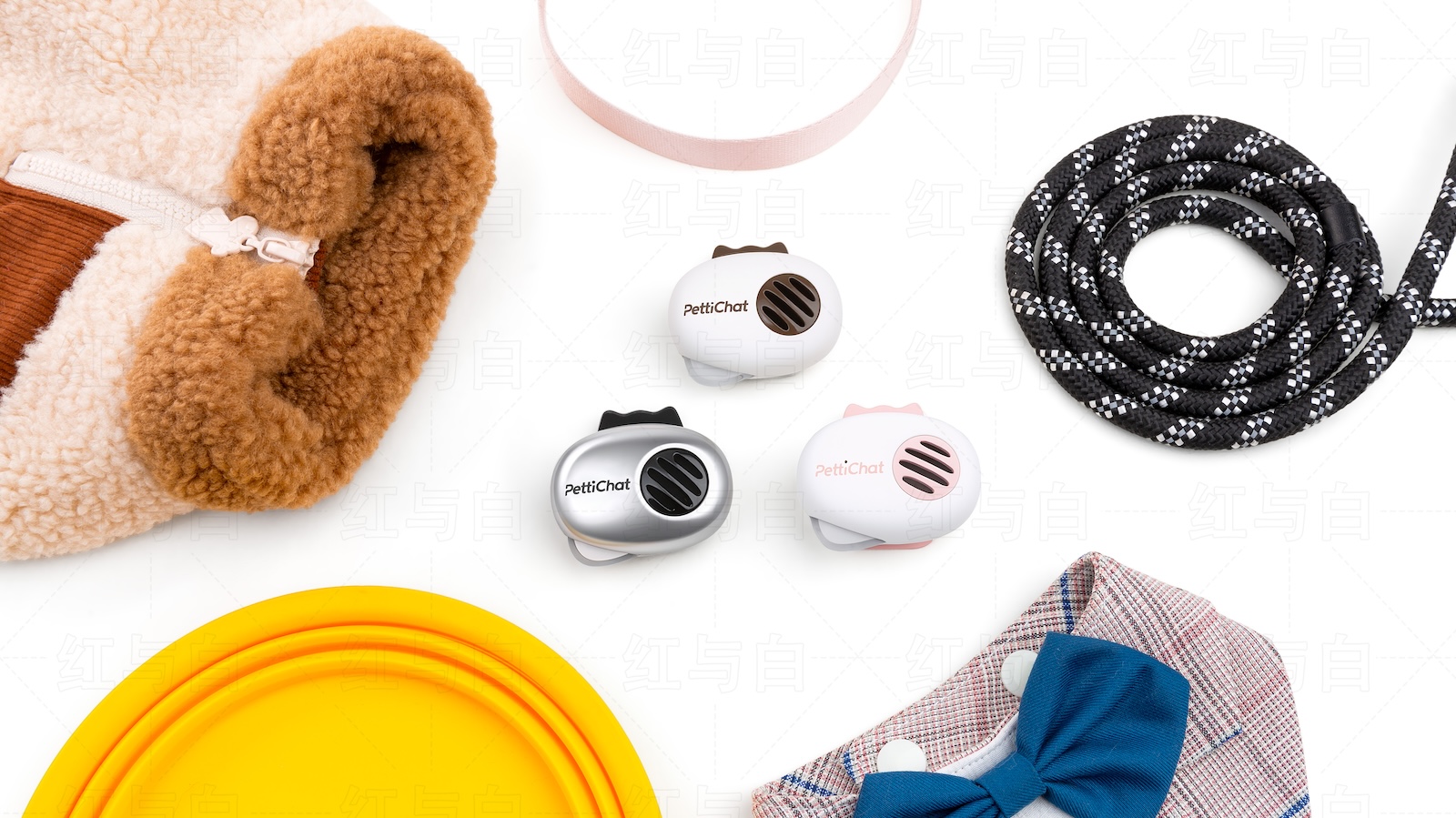
Developed by a Hong Kong-based team of AI engineers, animal behavior scientists, and veterinarians over two years of R&D, PettiChat is a 27.2g clip-on hardware device that attaches to any pet collar. It pairs with a companion app (iOS and Android, available in 170+ countries) and — crucially — works both ways: it translates your pet's vocalizations into human language, and translates your words back into signals your pet can respond to.
The technical foundation is what sets it apart from every prior product in this category. PettiChat runs what it calls a Pet-LLM (Large Language Model trained specifically on pet data) using a multi-modal AI framework that aligns audio input with "Video Ground Truth" — meaning the training labels were validated against observable animal behavior on video, not just manually annotated audio clips. The dataset underpinning it: 1.5 million+ real-world samples and 3,200+ hours of annotated pet video, built in collaboration with veterinarians and volunteers globally over two years.

Bowlingual — The 2002 Pioneer, Still Selling
Developed by Japanese toy company Takara (now Takara Tomy) and first sold in Japan in 2002, Bowlingual was genuinely pioneering for its time. Time magazine named it one of the "Best Inventions of 2002." Its inventors won the Ig Nobel Prize. The device categorizes dog barks into one of six standardized emotional categories (happy, sad, frustrated, on-guard, assertive, needy) and displays a representative phrase. The product instructions explicitly state these phrases are "for entertainment purposes only" — a telling caveat.
Bowlingual supports dogs only (50 breeds + 6 mixed breed types). It outputs in Japanese only on current available versions. Price: approximately $170 USD (sold out in most markets as of 2025).
MeowTalk — The App-Based AI Leader
MeowTalk, developed by Akvelon (founded by a former Amazon Alexa engineer), is a smartphone app — no hardware required. Since its November 2020 launch, it has amassed over 20 million downloads worldwide, 280 million+ meows recorded, and 8+ million cat profiles created. It interprets cat vocalizations into 11 general meow intents using an AI model trained on vocalizations collected and labeled by veterinarians.
A 2021 third-party study cited by the company puts MeowTalk at approximately 90% accuracy in controlled conditions. The app is free to download; full feature access requires a subscription at $2.99/month — roughly $35.88/year ongoing. It covers cats only.

Full Spec Comparison
| Specification | PettiChat | Bowlingual | MeowTalk |
|---|---|---|---|
| Form Factor | Hardware clip-on device | Hardware (collar mic + handheld unit) | Smartphone app only |
| Animals Supported | Cats & Dogs | Dogs only | Cats only |
| Translation Direction | Two-way (pet→human + human→pet) | One-way (dog→human) | One-way (cat→human) |
| AI Model | Pet-LLM, multi-modal | Rule-based emotion classifier (6 categories) | AI vocalization classifier (11 intents) |
| Training Dataset | 1.5M+ samples, 3,200+ hrs video | Not published | 280M+ meows recorded (ongoing) |
| Published Accuracy | 94.6% contextual accuracy | Not published ("entertainment only") | ~90% (2021 controlled study) |
| Response Time | 1.2 seconds | Near-instant (local processing) | Near-instant (local processing) |
| Weight | 27.2g | Collar mic + separate handheld unit | N/A (phone app) |
| Waterproof Rating | IP65 | Not published | N/A |
| Battery | 1hr charge = 1,000+ translations | AAA batteries (handheld) | Phone battery |
| Location Tracking | ✅ Built-in | ❌ No | ❌ No |
| App Companion | ✅ iOS + Android, 170+ countries | ❌ No app | ✅ iOS + Android |
| Chat History / Diary | ✅ Yes | ❌ 30 days local only | ✅ Yes (premium) |
| Certifications | CE-RED, FCC, RoHS | Not published | N/A |
| Subscription Required | ❌ None — lifetime free for backers | ❌ None | ✅ $2.99/month ($35.88/yr) |
| Entry Price | ~$120 (Super Early Bird) | ~$170 (sold out) | Free download / $2.99/mo |
| Languages | Multi-language (170+ countries) | Japanese only | Multiple |

The Accuracy Question: What Do These Numbers Actually Mean?
This is the most important section of any honest review in this category.
Bowlingual's approach to accuracy is settled: the manufacturer themselves labels the output as "for entertainment purposes only." Veterinarian Sophia Yin, reviewing the product, stated it was "not very useful because the translations aren't trustworthy and most don't make sense." Bowlingual categorizes into 6 fixed emotions — it is fundamentally a bark pattern classifier, not a language model.
MeowTalk's 90% accuracy figure comes from a 2021 study under controlled conditions — a meaningful benchmark, though "controlled conditions" in a lab differ substantially from a cat vocalizing while knocking your water glass off the counter. Importantly, the app classifies into 11 fixed intent states — it does not generate language or context-specific responses. Every "translation" maps to one of 11 preset outputs.
PettiChat's 94.6% figure is a different kind of claim. The methodology — training a Pet-LLM against "Video Ground Truth" (observed behavioral outcomes on video, not just audio labeling) — is more rigorous than simple audio classification. The dataset of 1.5M+ samples and 3,200+ hours of annotated video is, by their account, the largest labeled pet audio-video dataset publicly described. That said, PettiChat is a Kickstarter product and independent third-party testing has not yet been published. The 94.6% figure should be understood as the team's internal benchmark.
The honest summary: no product in this category has been independently verified at scale under real-world conditions. PettiChat's methodology is the most rigorous of the three on paper; MeowTalk has the most third-party adoption data; Bowlingual doesn't try to be accurate.
Why PettiChat Has Hit 770% Funding: A Critical Analysis
1. The Only Two-Way Device on the Market
Both Bowlingual and MeowTalk translate pet-to-human. PettiChat translates in both directions — you can speak to your pet and the device converts your words into signals calibrated to their behavioral response patterns. No other mass-market product does this. For pet owners who want genuine communication (not just emotional classification), this is a categorical leap.
2. Covers Both Cats and Dogs in One Device
Bowlingual is dogs-only. MeowTalk is cats-only. PettiChat covers both. For households with multiple pets — or owners who want one device without species restrictions — this alone justifies the comparison.
3. Hardware + AI = Better Data Than a Phone Mic
MeowTalk uses the microphone on your smartphone. Ambient noise, phone placement, and mic quality all affect results. PettiChat's clip-on device sits at the collar — it captures vocalizations at the source, in the correct acoustic environment, without the signal degradation of a phone held several feet away. For a system where audio input quality directly determines AI output quality, this hardware advantage is significant.
4. No Subscription — A Deliberate Positioning Decision
MeowTalk charges $2.99/month. Over 3 years, that's $107.64 in subscription fees on top of a free download. PettiChat's Kickstarter backers get lifetime free access — no monthly fees, ever. In a market where subscription fatigue is real, this is a clear and calculated positioning decision.
5. Built-In Location Tracking
Neither Bowlingual nor MeowTalk offer pet location tracking. PettiChat includes it as a standard feature — making the device serve double duty as both a translator and a GPS tracker. For pet owners who have experienced a lost animal, this functional overlap is meaningful value-add.
→ Back PettiChat on Kickstarter before May 14
Honest Limitations to Consider
- Kickstarter delivery risk: PettiChat is a crowdfunded hardware product. Despite the team's credibility, hardware campaigns carry inherent fulfillment risk. Budget for the possibility of delivery delays.
- 94.6% accuracy is self-reported: Until independent peer-reviewed benchmarks are published post-launch, treat this figure as the team's internal target, not a verified consumer guarantee.
- Two-way translation is genuinely novel — and unproven at scale: The concept of translating human speech into pet-meaningful signals is exciting but also the least scientifically established part of the product. The pet→human direction has a stronger evidence base than the human→pet direction across all products in this space.
- Bowlingual is largely unavailable: If you were considering Bowlingual as a direct alternative, note it is currently sold out in most Western markets and outputs only in Japanese.
Pricing at a Glance
| Tier | Approx. USD | Discount vs MSRP |
|---|---|---|
| Super Early Bird × 1 | ~$120 | 40% off |
| Early Bird × 1 | ~$130 | 35% off |
| KS Special × 1 | ~$150 | 25% off |
| Twin Pack × 2 | ~$239 | 40% off |
| Business Pack × 5 | ~$546 | 45% off |
| Business Pack × 10 | ~$991 | 50% off |
All tiers include free shipping and no subscription fees for Kickstarter backers. Campaign closes May 14, 2026.
Verdict
Bowlingual is a 2002 novelty gadget that honestly labels itself "for entertainment purposes only." It belongs in a museum display case next to the Tamagotchi, not in a serious buyer's comparison.
MeowTalk is the best product currently available for cats only, and its 20 million downloads prove genuine consumer demand. At $2.99/month for full features, it is affordable — but it is an app, limited to your phone microphone, one species, and one direction of communication.
PettiChat represents the most technically ambitious attempt at this problem to date: two species, two directions, dedicated hardware, IP65 durability, location tracking, and no subscription. Its 94.6% accuracy claim, while self-reported, is grounded in the most methodologically rigorous training approach of any consumer product in this category. At ~$120 Super Early Bird, it is priced below the long-discontinued Bowlingual.
The question isn't whether PettiChat is perfect — it's a Kickstarter product and the two-way communication claim is still unproven at consumer scale. The question is whether the combination of hardware design, dataset scale, pricing, and feature breadth represents a meaningful step forward for pet-human communication technology. It does.
→ Back PettiChat on Kickstarter — Campaign ends May 14, 2026
All PettiChat specifications cited in this article are sourced directly from the official Kickstarter campaign page. Bowlingual specifications from JapanTrendShop retail listing and Wikipedia product documentation. MeowTalk pricing from Google Play Store listing; accuracy figure from 2021 third-party study as cited by Akvelon.


